
The main disadvantages of AI in digital marketing are confident errors, off-brand output, wasted ad spend and mistakes that compound, and almost all of them come from leaving AI unsupervised. The tool is rarely the problem; the missing review step is. Put expert review and quality assurance around AI, and those same risks turn back into speed, scale and better results.
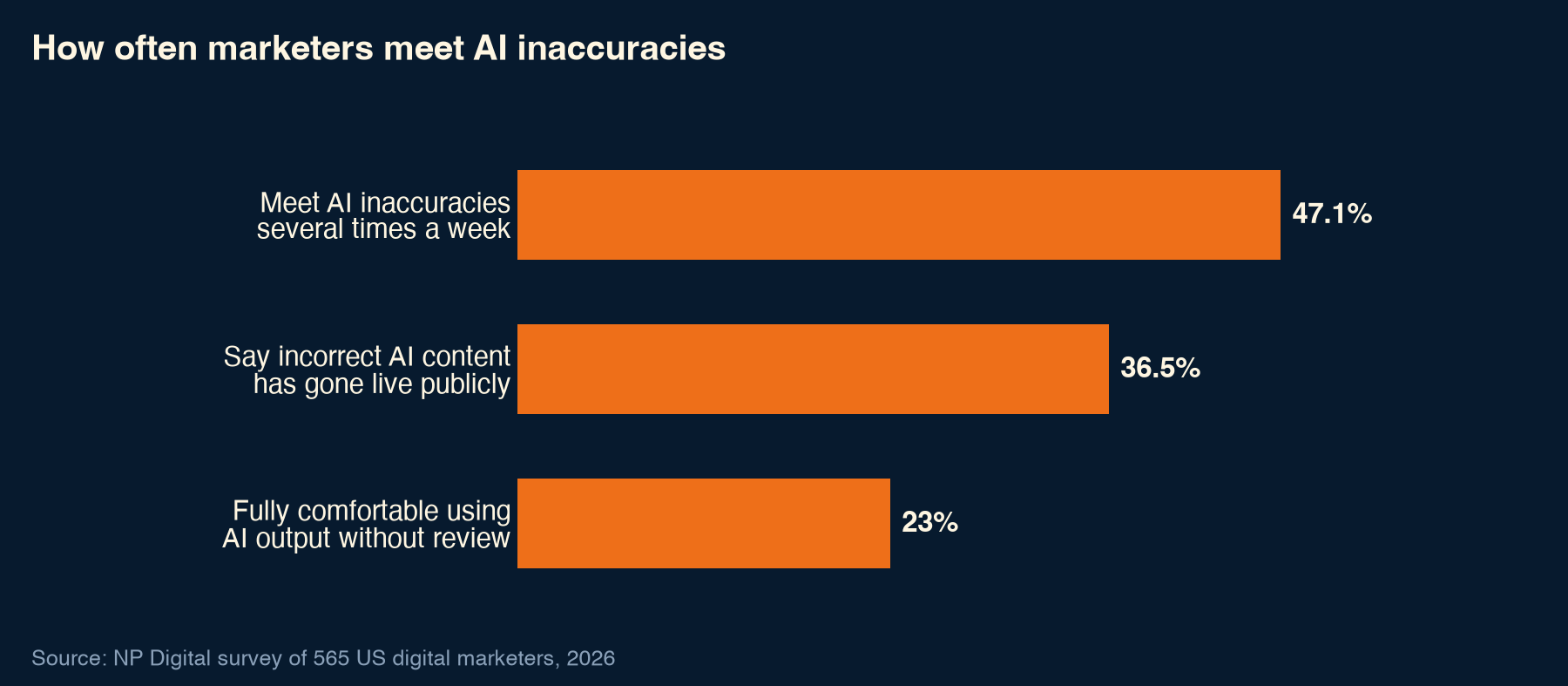
These risks of AI in marketing show up often. NP Digital's AI hallucination data study surveyed 565 US-based digital marketers and found that "Nearly half of marketers (47.1 percent) encounter AI inaccuracies several times a week." That is a review problem, and it has a review solution.
This guide covers where AI earns its place across SEO, paid ads and websites, where it slips when nobody is watching, and the checklist we use to keep it on track.
Contents
- What AI does well in digital marketing
- The disadvantages of AI in marketing all share one cause
- Unsupervised AI in SEO
- Unsupervised AI in paid ads
- Unsupervised AI in website builds
- AI vs human content: the answer is both
- Common mistakes in AI content strategy
- What supervised AI looks like: a practical checklist
- How Ascend Group Media uses AI
- Getting the speed of AI without the hidden cost
- Frequently Asked Questions
- Resources
What AI does well in digital marketing
Start with the upside, because it is the reason any of this matters. AI is fast. It turns a blank page into a first draft in minutes, summarizes research, writes ten ad headline variations to test, and pulls reporting together so your team spends its time on decisions instead of spreadsheets.
In ad platforms, automated bidding and targeting spot patterns across far more signals than anyone could watch by hand. For websites, AI builders and coding assistants can get a working page live much faster than a traditional build.
That is the "advantages" half of the advantages and disadvantages of AI in digital marketing, and it is a big half. Even the organizations studying AI's weak spots most closely stay positive about it. Peter Archer, Programme Director, Generative AI at the BBC, said this in the European Broadcasting Union study:
"We're excited about AI and how it can help us bring even more value to audiences. But people must be able to trust what they read, watch and see. Despite some improvements, it's clear that there are still significant issues with these assistants."
That is the right balance for any business: use AI for what it does well, and make trust somebody's job.
The disadvantages of AI in marketing all share one cause
Look closely at almost any list of the disadvantages of AI in marketing and the same pattern shows up. The tool did roughly what it was asked. The missing piece was the step after that: someone with expertise reading the output, checking the facts and approving it before it reached customers, search engines or an ad budget.
We call that unsupervised AI. Unattended, unchecked, on autopilot, set-and-forget: the label changes, but the cause stays the same. Here is how it plays out.
AI hallucinations in marketing: confident and wrong
An AI hallucination is when a tool produces something that sounds right but is not true, such as a statistic, quote, source or product detail that does not exist. The risk comes from the confidence: a hallucinated figure reads exactly like a real one.
NP Digital's study shows how often these errors reach the public: "More than a third (36.5 percent) say hallucinated or incorrect AI content has gone live publicly." The European Broadcasting Union study led by the BBC, which tested AI assistants answering news questions, found that "45% of all AI answers had at least one significant issue." It also found "31% of responses showed serious sourcing problems" and "20% contained major accuracy issues".
The fix is easy to describe and easy to skip: trace every claim back to its original source before it goes live. If nobody can find the source, the claim does not run.
Off-brand content when deadlines bite
The second slip is quieter. An Optimizely survey reported by IT Brief of 2,003 marketing leaders found that 25% knowingly publish off-brand AI content when facing tight deadlines, and 76% spend at least three hours a week editing, fact-checking or correcting AI output.
Tara Corey, SVP Marketing at Optimizely, described the gap: "AI was supposed to give marketers room to think. What most teams got instead was more to manage." On why corners get cut, she added: "When the pressure doesn't stop and the infrastructure isn't there, everyone improvises."
Social media feels this most, because posts and replies go out daily and an unchecked caption can reach customers before anyone has read it. The answer is a brand voice guide the tool works from and a person who signs off, so deadlines stop deciding how your brand sounds.
Real examples of missing human review
Each of these public cases teaches the same lesson: the review step was skipped or too light.
- Publishing. "CNET issued corrections on 41 of the 77 stories the outlet published that were written using an artificial intelligence tool", according to Talking Biz News, summarizing The Verge's reporting.
- Licensed content. A licensed summer reading list in the Chicago Sun-Times listed 15 books, and 10 did not exist. The content partner confirmed "a freelancer used an AI agent to write the article," CBS News Chicago reported.
- Professional services. Deloitte Australia agreed to partially refund the A$440,000 fee for a government report that included "a fabricated quote from a federal court judgment and references to nonexistent academic research papers." The revised version "included a disclosure that a generative AI language system, Azure OpenAI, was used in writing the report," according to the Associated Press.
- Customer service. In Moffatt v. Air Canada, a Canadian tribunal decision, the airline was held responsible for wrong fare information from its website chatbot. The tribunal wrote: "I find Air Canada did not take reasonable care to ensure its chatbot was accurate," and "It should be obvious to Air Canada that it is responsible for all the information on its website," as quoted by McCarthy Tétrault.
The takeaway: anything AI produces under your name belongs to you, so a person needs to check it first.
Unsupervised AI in SEO
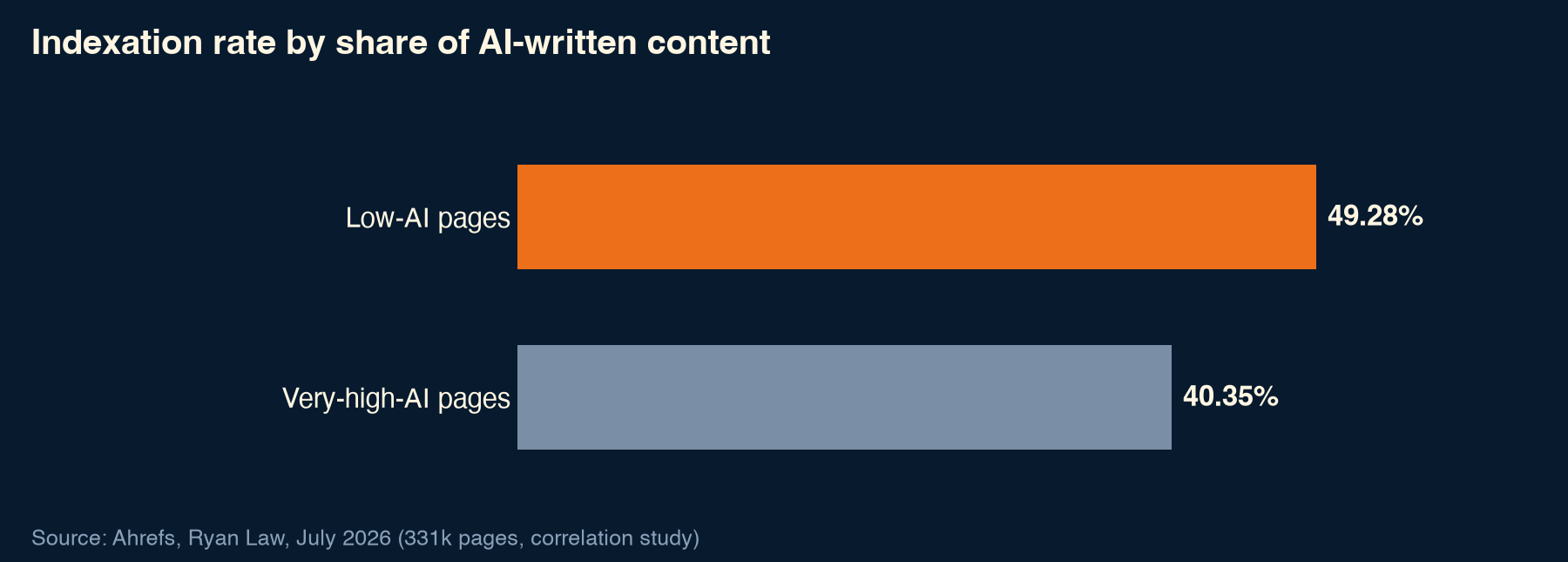
Google looks at whether content helps the reader, not at which tool wrote it. Ryan Law at Ahrefs put it plainly: "Google is not against AI content; it is against bad content." The catch is that heavily AI-written content left unedited tends to slide toward bad. In an Ahrefs correlation study of 331k pages, which used an AI detector to estimate AI involvement, Law found "increasing use of AI correlates with decreasing content quality." Indexation rates were 49.28% for low-AI pages and 40.35% for very-high-AI pages. A page that is not indexed cannot rank, and a page that cannot rank brings in no leads.
 The SEO articles in this series go deeper. Whether Google penalizes AI content explains how Google treats AI-assisted pages. Our guide to scaled content abuse covers what happens when volume replaces usefulness. Using ChatGPT for SEO shows where it speeds up the work and where a strategist needs to take over.
Unsupervised AI in paid ads
Automated campaign types and smart bidding are some of the most useful features in a modern ad account. On autopilot, though, they can move budget in ways nobody approved. Auto-applied recommendations can change bids, keywords and budgets, and automated campaigns can end up competing with your own manual ones.
Optmyzr's study found that "91.45% of 503 accounts had keyword overlap between Search and PMax." Put simply, Google's automated all-channel campaigns and standard Search campaigns were often chasing the same searches. When that happens, it is harder to see which campaign is producing your results and where your budget is really going.
Three articles in this series cover the detail: what to watch with Performance Max left unattended, the Google Ads automation risks that come from auto-applied changes, and the Meta Advantage+ risks to check on the social side.
Unsupervised AI in website builds
AI website builders and AI-written code are a real shortcut: a site that used to take weeks can be live in days. Without checks, that speed can also ship slow pages, weak technical SEO, security gaps and accessibility shortcuts. Often nobody notices until rankings or enquiries start to drop.
Security makes the point most clearly. The Veracode 2025 GenAI Code Security Report found that "45% of code samples failed security tests and introduced OWASP Top 10 security vulnerabilities into the code." The OWASP Top 10 is a widely used list of the most common web application security risks. These are known weaknesses, and a pre-launch security review is designed to find them.
To go further, read our guides to AI-generated websites, the security risks of vibe-coded websites, and what to check before relying on accessibility overlays.
AI vs human content: the answer is both
People usually treat AI vs human content as a contest, but the better question is how the two work together. When you compare AI-only vs AI-human edited content, who typed the first draft matters less than whether someone added the parts that need a person: fact-checking, your brand voice, original insight from real experience, and accountability for the result.
Most marketers already work this way. NP Digital found "only 23 percent of marketers felt fully comfortable using AI output without review." The Ahrefs data points the same way: quality tends to drop as unedited AI involvement rises. So in the AI content vs human content debate, the strongest answer is AI for speed and people for judgment.
| AI only | AI plus expert review | |
|---|---|---|
| Speed | Fastest possible first draft | Fast drafts, with review time planned in |
| Factual accuracy | Unverified; claims may be hallucinated | Every claim traced to a source |
| Brand voice | Generic or inconsistent | Checked against your voice guide |
| Original insight | Draws on existing patterns | Adds first-hand experience and expertise |
| Risk of public errors | Higher; errors can go live unseen | Lower; errors caught before launch |
| Who is accountable | Unclear | A named owner signs off |
Common mistakes in AI content strategy
The most common mistakes in AI content strategy are gaps in process, and that is good news, because process can be fixed.
- Publishing without a fact-check. Make a traceable source a condition of publishing.
- No brand voice guide. Give the tool and the editor the same written standard to work from.
- Volume targets over usefulness. Measure pages by leads and rankings rather than by how many you publish.
- No named owner for sign-off. When everyone is responsible, nobody checks the work.
- Trusting AI-quoted statistics. Go to the original source every time.
- Set-and-forget automation in ad accounts. Put a recurring review in the calendar.
- Launching AI-built pages without review. Run technical and security checks before go-live.
What supervised AI looks like: a practical checklist
Here is where AI pays off. Supervision keeps all of AI's speed and adds a short, repeatable set of checks. We work from this list across SEO, ads and websites:
- A named human owner for every AI-assisted piece of work
- Every statistic traced to its original source
- A brand voice check against your written guide
- A legal and claims check on pricing, regulated or sensitive statements
- Weekly spot-checks of ad search terms and placements
- A review of auto-applied changes in every ad account
- A pre-launch technical, speed, accessibility and security review on any AI-built page
- Chatbots and automated replies tested against real customer questions
- Open disclosure of AI use where your audience or contract expects it
- A log of what AI produced and who approved it
None of these steps slows a good team down for long. Each one protects the time AI saved from being lost to corrections, refunds or rebuilt pages.
How Ascend Group Media uses AI
Ascend Group Media uses AI every day, wherever it helps: faster drafts, research, data analysis and testing more ideas in less time. Experienced people stay in charge of strategy, review and QA. Our search engine optimization team edits and fact-checks before anything is published. Our paid advertising management team reviews automated changes and search terms. Our website development team runs technical, speed, accessibility and security checks before launch. You can see how we work from first consultation through to reporting.
Getting the speed of AI without the hidden cost
The disadvantages of AI in digital marketing are real, and almost all of them can be avoided. They come from unattended output, not from the technology itself. With a named owner, sourced facts and a review step on every campaign and page, you get to keep AI's speed and drop the hidden costs.
If you want that balance in your SEO, ads and website, talk to our team at Ascend Group Media. We'll show you how AI and expert review fit together for your business.
Frequently Asked Questions
What are the disadvantages of AI in digital marketing?
The main disadvantages of AI in digital marketing are confident factual errors, off-brand content, wasted ad spend and mistakes that compound across campaigns and pages. Almost all of them have one cause: AI output going live without expert review. With a named owner, a fact-check and a QA step in place, the same tools become a dependable way to work faster.
What are the advantages and disadvantages of AI in digital marketing?
The advantages are speed, scale and pattern-spotting: faster drafts, more ad variations, quicker reporting and faster site builds. The disadvantages are hallucinated facts, generic or off-brand copy, automated ad settings moving budget nobody approved, and AI-built pages launched without technical or security checks. The advantages come from the tool. Most of the disadvantages come from skipping review.
What are AI hallucinations in marketing, and how do you catch them?
An AI hallucination is output that sounds correct but is not true, such as an invented statistic, quote, source or product detail. To catch them, trace every claim to its original source before publishing, check names, numbers and dates by hand, and drop any statistic you cannot source. Having a named reviewer who signs off makes the habit stick.
Is AI-generated content worse than human content?
Not by default. As Ahrefs' Ryan Law puts it, Google is not against AI content; it is against bad content. The difference is editing. AI-only content often skips fact-checking, brand voice and original insight. AI-assisted content edited by an expert keeps the speed and adds judgment. The strongest approach is both working together.
How does AI disadvantage businesses when nobody reviews it?
Unreviewed AI costs businesses money and trust. Wrong facts damage credibility and can create legal exposure: a Canadian tribunal held Air Canada responsible for its chatbot's wrong fare information. Unchecked ad automation can spend budget on overlapping or unapproved targeting. Unreviewed AI-built pages can launch with slow load times or security gaps that cost rankings and leads.
Will AI replace digital marketers?
AI is changing the work more than it is replacing the people. Drafting, variations and reporting get faster, so more of a marketer's time goes to strategy, review, quality assurance and decisions about budget and brand. The public examples in this guide show why that matters: when the human review step is missing, errors reach customers. Marketers who can direct and check AI become more valuable.
How is AI changing digital marketing?
AI is speeding up content drafting, ad testing, reporting and website builds, and ad platforms now automate more bidding and targeting decisions. Search is changing too, as AI assistants answer more questions directly. All of this makes accurate, well-sourced content more valuable, along with the people who check AI output before it goes live.
How do you measure whether AI is helping your marketing?
Measure AI-assisted work against the same business numbers as everything else: leads, sales, cost per result and rankings. Compare campaigns or periods with and without AI help, and track time saved alongside the quality of what ships. If output goes up but leads, sales or rankings stay flat, AI is producing volume rather than value, and your review process needs tightening.
Resources
- NP Digital (Neil Patel), "AI hallucination data study," February 3, 2026, updated April 25, 2026
- IT Brief, "Optimizely study finds marketers cut corners on AI," June 30, 2026
- European Broadcasting Union, international study led by the BBC on AI assistants and news, October 22, 2025
- Talking Biz News, "CNET found errors in more than half of its AI stories," January 25, 2023
- CBS News Chicago, Chicago Sun-Times summer reading list with AI-generated titles, May 20, 2025
- Associated Press via News4Jax, "Deloitte to partially refund Australian government for report with apparent AI-generated errors," October 7, 2025
- McCarthy Tétrault, "Moffatt v. Air Canada: A misrepresentation by an AI chatbot," February 19, 2024
- Ahrefs (Ryan Law), "Google doesn't punish AI content," July 27, 2026
- Optmyzr (Frederick Vallaeys), "Is PMax cannibalizing Search?," July 31, 2025
- Veracode, 2025 GenAI Code Security Report, July 30, 2025
From the blog.



Let’s put this to work for you.
Tell us where you want to go. We’ll map the fastest path to revenue, no obligation.