
An AI-generated website is a fast, low-cost way to get your business online, often in hours rather than weeks. The risk is not the AI. It is an unchecked build that goes live with nobody experienced reviewing it. That is where the costs show up: slower pages, lost rankings and fewer leads.
Speed alone is worth real money. In the Google and Deloitte Milliseconds Make Millions study, a 0.1-second improvement across a bundle of mobile speed metrics "increases conversion rates by 8.4% for retail sites and 10.1% for travel sites." Below, we cover where unchecked builds lose that value and what a reviewed build does instead.
Contents
- What is an AI-generated website?
- Where an unchecked AI build costs your business
- Which AI website builder is best for SEO?
- How to tell if a website is AI-generated
- Will AI replace web designers?
- A supervised AI website build: your pre-launch checklist
- Frequently Asked Questions
- Get your AI-generated website reviewed
- Resources
What is an AI-generated website?
An AI-generated website is a site whose layout, copy, images or code are produced by an AI website builder or a prompt, usually in minutes. You describe your business, and an AI site generator gives you a working draft: a homepage, service pages, placeholder copy and a color scheme.
That is genuinely useful. AI is excellent at fast first drafts. It can show you several layout options before lunch, and it can put an idea in front of customers the same day. So yes, AI can generate a website for you.
The catch is the final stretch. Engineer Addy Osmani, writing on his Substack, said of AI coding tools: "They can get 70% of the way there surprisingly quickly, but that final 30% becomes an exercise in diminishing returns." In our experience, that last 30% is where a business website earns its money. It covers speed, search visibility, accurate content and a clear path to an enquiry.
Where an unchecked AI build costs your business
Each risk below follows the same pattern: what AI does well, what goes wrong when nobody checks, and what a reviewed build does instead. None of these problems is built into AI. They come from launching on autopilot.
Heavy code and slow pages
Lead generation sites in the Milliseconds Make Millions study saw "a 21.6% improvement in the number of users that progressed to the Form Submission Page" after speed gains. Page speed shows up directly in your lead count.
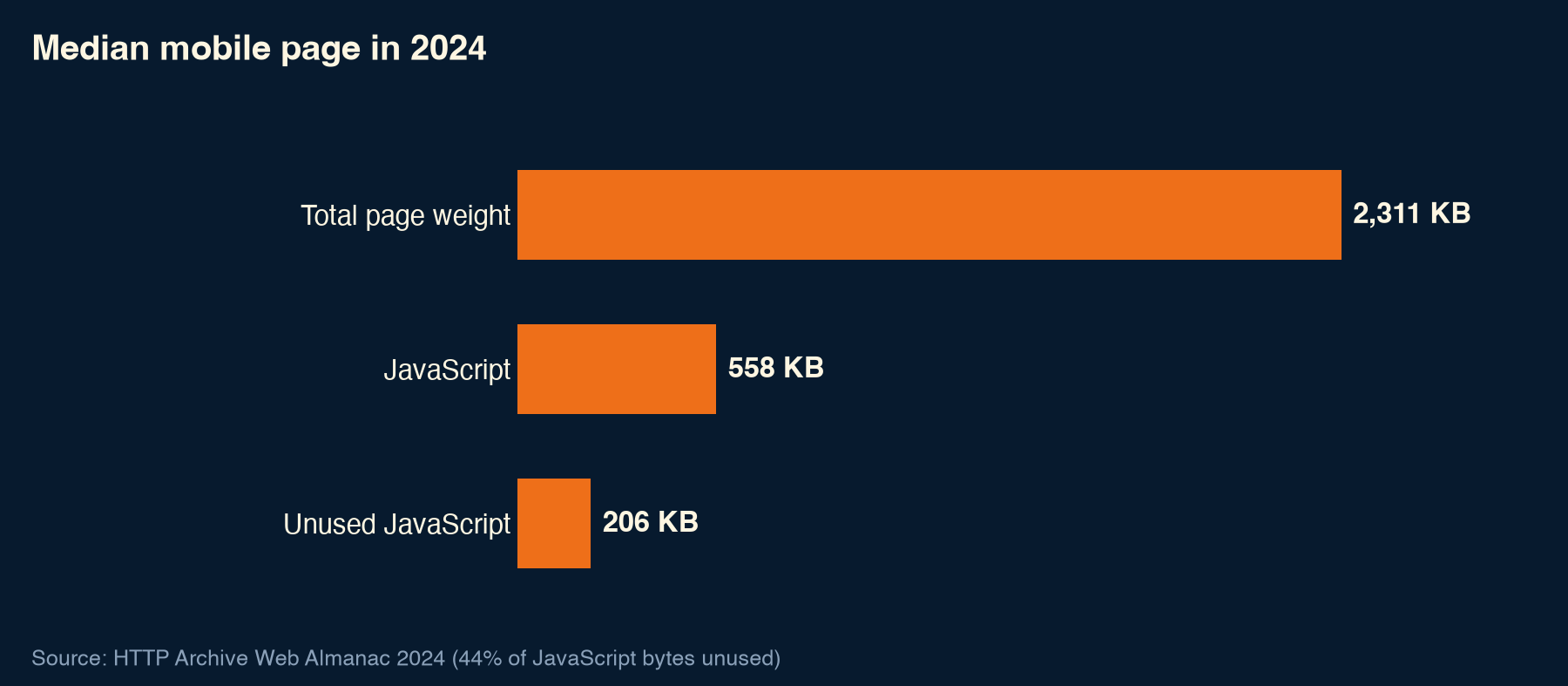
AI builders are quick to add sections, animations and features, and they rarely remove anything. The typical page is already heavy. The HTTP Archive Web Almanac 2024 found "the median page weight for a mobile page was 2,311 KB." JavaScript, the code that makes pages interactive, makes up a large share. Its JavaScript chapter puts the median at "558 kilobytes on mobile," with "206 kilobytes" unused, which is "44% of bytes delivered."
Generated code tends to add more rather than tidy up. GitClear's 2025 research into AI code assistants in general reported "4x more code cloning" (GitClear sells code analysis tools, so bear that in mind).
Google's Core Web Vitals measure how fast the main content appears, how quickly the page responds and how much it jumps around. The "good" mark is: "LCP should occur within 2.5 seconds of when the page first starts loading."
Technical SEO gaps that search engines and AI assistants notice
Technical SEO is the behind-the-scenes setup that lets search engines find, read and understand your pages. It is the part of AI website builder SEO that people check least.
Speed plays a measured role. Google Search Central says Core Web Vitals, "along with other page experience aspects, aligns with what our core ranking systems seek to reward." That makes it one signal among many, not a shortcut.
Rendering matters more than most owners realize. Rendering means running a page's code to build what a visitor sees. Google says "Googlebot queues pages for both crawling and rendering" and warns that "not all bots can run JavaScript." Server-side rendering, which builds the page on the server so the content arrives ready-made, "is still a great idea."
AI assistants raise the stakes. A crawler is a program that reads pages for a search engine or AI tool. Research by Vercel and MERJ found that "none of the major AI crawlers currently render JavaScript." OpenAI's GPTBot and Anthropic's ClaudeBot fetched JavaScript files but did not run them. That was measured on December 17, 2024, and crawler behavior may have changed since. Even so, a site that only builds its content in the browser can look empty to those crawlers.
Then there are the everyday gaps. We often see missing or duplicate title tags (the clickable headline shown in search results) and meta descriptions, no structured data, messy URLs and no redirect plan when an old site is replaced.
Generic design that does not convert (AI generated website design)
AI generated website design is a strong starting point. You get clean, modern layouts in minutes. Left unchecked, though, the result often looks like a website template: the same hero, three icon boxes, stock phrasing and a "Get Started" button that has nothing to do with how your business actually sells.
A reviewed build designs around your customer journey. That means your real offer, the proof you already have (reviews, case studies, accreditations) and a call to action that matches the next step a buyer takes. If you sell through quotes, the page should make requesting one effortless.
Inconsistent or inaccurate content (AI-generated website content)
AI-generated website content is fluent and fast, which is exactly why errors slip through. Across a full site we see copy that contradicts itself between pages, service details the business does not offer, and a voice that drifts from friendly to formal halfway down a page.
On a business site, an unchecked claim becomes a customer complaint. If a page promises a turnaround or a feature you do not provide, your team pays for it on the phone. The same pattern runs through unsupervised AI in digital marketing more broadly: the draft is quick, and a person should still sign off every service, price and promise.
Nobody owns the site after launch
The best part of an AI build is how quickly it goes live. The risk is that launch day becomes the last day anyone looks at it. Updates, plugins, backups, speed checks and content refreshes all need an owner and a schedule.
If your site was built from prompt-generated code, read our guide to the security risks of vibe-coded websites. If anyone suggests a one-click accessibility fix, our article on accessibility overlays explains what to check first. And if your current site is already showing its age, these signs your website needs a redesign will help you decide what comes next.
Which AI website builder is best for SEO?
Here is the straight answer: the builder matters less than whether the finished site passes a short list of technical checks, and whether someone experienced verifies them. The best AI website builder for SEO is the one that lets you control the items below and actually produces good results on them for your pages.
| Check | Why it matters to your business | Good result |
|---|---|---|
| Mobile speed | Faster pages move more visitors toward an enquiry or sale | LCP within 2.5 seconds, INP of 200 milliseconds or less, CLS of 0.1 or less |
| Content in the page source | "not all bots can run JavaScript," and major AI crawlers did not render it in December 2024 | Key text visible before any scripts run |
| Editable title tags and meta descriptions | They shape how your pages appear and get clicked in search | A unique pair on every page |
| Clean, editable URLs and redirects | Protects rankings when you replace an old site | Readable URLs, every old page redirected |
| Trim unused scripts and images | 44% of mobile JavaScript bytes go unused at the median | Unused code and oversized images removed |
| Export or ownership of content | Lets you move or rebuild without starting over | Your content can be exported in full |
The same checks settle the "AI website builder vs WordPress" question too, which we answer in the FAQ below.
How to tell if a website is AI-generated
Ever landed on a site and felt you had read it somewhere before? That is usually the first sign. Here is what to look for:
- Interchangeable copy that could describe any business in any town.
- The same section pattern repeated on every page.
- Vague or inconsistent service details that change from page to page.
- Placeholder images that show generic people, offices or handshakes.
- Slow mobile pages weighed down by features nobody asked for.
You do not need a checker tool to spot these signals. You also don't need to hide that AI was involved, because visitors rarely care how a site was made. They notice when it feels generic or does not answer their question. The goal is a site that clearly reads as yours.
Will AI replace web designers?
No, but it is changing what web designers spend their time on. AI speeds up the first draft, the layout options and the placeholder content. Strategy, conversion design, technical SEO and quality checks still need people who know how your customers buy.
That is Osmani's 70% point again from the designer's side. The quick part has got quicker, and the final stretch still takes judgment.
At Ascend Group Media, we use AI wherever it speeds up the work, and we put experienced people in charge of strategy, review and QA. In our experience, that combination gives you the speed of AI and a site you can trust to rank and convert.
A supervised AI website build: your pre-launch checklist
The opportunity here is real: an AI build plus a structured review gets you to a strong launch faster than starting from a blank page. Run these ten checks before your site goes live, then again on a schedule.
- Mobile speed tested against Google's "good" thresholds: 2.5 seconds, 200 milliseconds and 0.1.
- Page weight and unused scripts trimmed.
- Key content present in the page source, not only after scripts run.
- A unique title tag and meta description on every page.
- Clean URLs, with redirects from any old pages.
- Every service, price and claim checked by a person.
- Brand voice consistent across all pages.
- Forms tested end to end, through to the inbox.
- Analytics and conversion tracking confirmed.
- A named owner and a maintenance schedule.
If you would rather hand this list to specialists, it is the same process our website development work follows on every build.
Frequently Asked Questions
Can AI generate a website for me?
Yes. An AI website builder or prompt-based tool can produce a full draft site, with layout, copy, images and code, usually in minutes. That is a great way to get an idea live quickly. Before you rely on it for leads, have someone check speed, technical SEO, content accuracy and forms, because those are the areas an unchecked build most often misses.
Are AI-generated websites good for SEO?
They can be, provided the finished site passes the technical basics. Google says Core Web Vitals, "along with other page experience aspects, aligns with what our core ranking systems seek to reward." Beyond speed, check that key content sits in the page source, every page has a unique title tag and meta description, URLs are clean and old pages redirect properly.
AI website builder vs WordPress: which is better for a small business?
Both can serve a small business well. The better choice is whichever lets you pass the same checks: mobile speed within Google's thresholds, content visible in the page source, editable title tags and URLs, the ability to trim unused scripts, and full ownership of your content. Compare them against your own needs, and then make sure someone experienced verifies the finished site.
Is an AI-generated website a good choice for a small business?
It can be a smart choice, especially when budget and time are tight. The speed and low starting cost are real benefits. The value depends on what happens next: a person checking every claim, testing forms and tracking, trimming page weight, and owning the site after launch. With that review in place, an AI build can give a small business a strong start.
What does an AI-generated website really cost?
The upfront cost is usually low. The real cost shows up over time: slower pages that convert fewer visitors, technical gaps that hold back rankings, content that needs correcting, rework when the site cannot grow with you, and upkeep nobody planned for. Budget for a proper review and ongoing maintenance, and the total cost of ownership stays predictable.
Get your AI-generated website reviewed
An AI-generated website is a smart way to move fast. Put an experienced review on top of that speed and you get a site that loads quickly, reads as yours and turns visitors into enquiries.
If you have already built your site with AI, or you are about to launch one, our web development team can review it against the checks above and show you where the quick wins are. Contact us when you're ready, and we'll take it from there.
Resources
- Web Vitals, web.dev (Google)
- Understanding Core Web Vitals and Google search results, Google Search Central
- Milliseconds Make Millions, Google and Deloitte, web.dev case study (2020)
- Page Weight, HTTP Archive Web Almanac 2024
- JavaScript, HTTP Archive Web Almanac 2024
- The rise of the AI crawler, Vercel and MERJ (December 17, 2024)
- Understand JavaScript SEO basics, Google Search Central
- AI Copilot Code Quality 2025 research, GitClear
- The 70% problem: Hard truths about AI-assisted coding, Addy Osmani, Substack (December 4, 2024)
From the blog.



Let’s put this to work for you.
Tell us where you want to go. We’ll map the fastest path to revenue, no obligation.