
Scaled content abuse is Google's name for publishing many pages mainly to manipulate search rankings rather than help people, however those pages are produced. AI makes it easy to generate hundreds of pages in an afternoon. That makes unattended AI mass-publishing, where nobody checks whether each page earns its place, the fastest route into this policy.
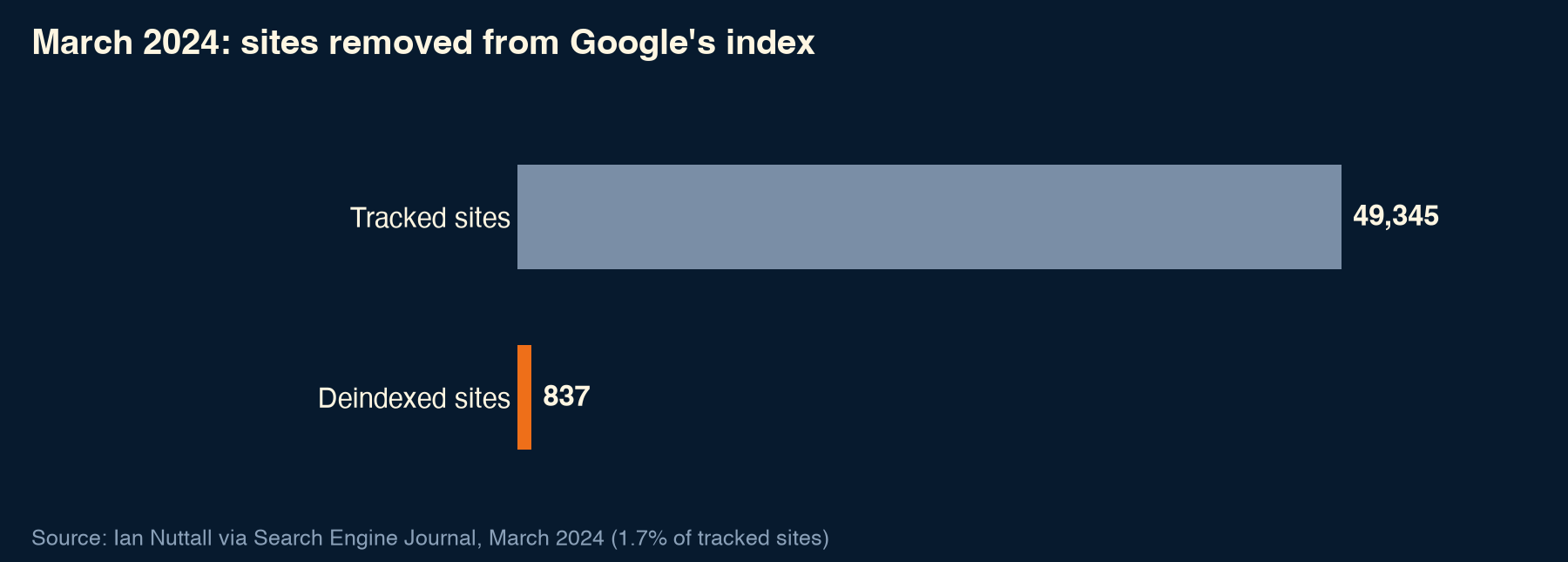
The stakes are real. After Google's March 2024 update, independent tracking of 49,345 sites by Ian Nuttall found that "837 websites had been removed entirely from Google's search index," as Search Engine Journal reported. Those sites had been receiving "over 20.7 million organic search visits per month."
AI isn't the problem here, and neither is scale. Location pages, programmatic pages and large product catalogs can all be genuinely helpful. The risk comes from publishing on autopilot. This guide is part of our series on unsupervised AI in digital marketing. It covers what the policy says, what happens to sites that cross the line, and how to scale safely.
Contents
- What scaled content abuse means
- Google's scaled content abuse policy: where it came from
- Google search spam policies on scaled content abuse: the examples
- What happens to sites that get caught
- Why "set-and-forget" AI publishing runs into this policy
- Scaled content done right: a pre-publish checklist
- How Ascend Group Media approaches pages at scale
- Frequently Asked Questions
- Resources
What scaled content abuse means
Google Search Central's scaled content abuse policy appears on its Spam policies for Google web search page. The definition is short:
"Scaled content abuse is when many pages are generated for the primary purpose of manipulating search rankings and not helping users. This abusive practice is typically focused on creating large amounts of unoriginal content that provides little to no value to users, no matter how it's created."
In plain English, "manipulating search rankings" means building pages to take up spots in Google instead of answering anyone's question. The page is there for the crawler, not the customer.
The phrase to underline is "no matter how it's created." The policy judges the result, not the tool. A batch of thin pages typed by hand breaches it just as surely as a batch generated by a model. An AI-assisted page that a specialist has checked and enriched can be exactly what Google wants to rank.
Google's scaled content abuse policy: where it came from
Google introduced the policy on March 5, 2024, alongside the March 2024 core update. In the announcement on the Search Central Blog, Chris Nelson wrote: "Today, we're announcing three new spam policies against bad practices we've seen grow in popularity: expired domain abuse, scaled content abuse, and site reputation abuse."
The post said the new policy "builds on our previous spam policy about automatically-generated content, ensuring that we can take action on scaled content abuse as needed, no matter whether content is produced through automation, human efforts, or some combination of human and automated processes."
It also restated Google's position on automation: "Our long-standing spam policy has been that use of automation, including generative AI, is spam if the primary purpose is manipulating ranking in Search results." Purpose is the test, not tooling. For the broader question, see our answer to does Google penalize AI content.
Google search spam policies on scaled content abuse: the examples
Google's spam policies list five scaled content abuse examples, introduced with "Examples of scaled content abuse include, but aren't limited to:"
- "Using generative AI tools or other similar tools to generate many pages without adding value for users"
- "Scraping feeds, search results, or other content to generate many pages (including through automated transformations like synonymizing, translating, or other obfuscation techniques) where little value is provided to users"
- "Stitching or combining content from different web pages without adding value"
- "Creating multiple sites with the intent of hiding the scaled nature of the content"
- "Creating many pages where the content makes little or no sense to a reader but contains search keywords"
What could these look like in a real business? The table pairs each one with a hypothetical illustration (not a real case) and the helpful version of the same idea.
| Google's example | Abusive version (illustration) | Helpful version (illustration) |
|---|---|---|
| AI pages without added value | Hundreds of city pages with identical copy and only the town name swapped | City pages with real local details: service areas, team, reviews, local pricing |
| Scraped or rewritten feeds | Product descriptions rewritten by AI straight from a supplier feed | Descriptions that add your own specs, photos, sizing advice and stock status |
| Stitched content | Blog posts assembled from competitors' top-ranking articles | Posts built on your own expertise, data or testing |
| Multiple sites hiding scale | A network of near-identical microsites selling the same service | One strong, well-structured site |
| Keyword-filled nonsense | Pages that read like keyword lists strung into sentences | Pages written for a reader first, with keywords used naturally |
Google's helpful content guidance draws the same line. It says "automatically generating pages from feeds or using generative AI to produce large amounts of text without manual oversight or curation represents little to no effort." The key words are "without manual oversight or curation." That oversight is the difference between the two right-hand columns.
What happens to sites that get caught
Google's spam policies page is direct: "Sites that violate our policies may rank lower in results or not appear in results at all." It adds: "We detect policy-violating practices both through automated systems and, as needed, human review that can result in a manual action."
A manual action is a penalty applied after a human review. If you get one, it shows up in the Manual Actions report in Search Console, Google's free dashboard for site owners. According to Google's Manual Actions report help page, the "Major spam problems" action applies when "The site appears to use aggressive spam techniques such as scaled content abuse, cloaking, and/or other repeated or egregious violations of Google's spam policies." Google also notes that "Most issues reported here will result in pages or sites being ranked lower or omitted from search results without any visual indication to the user."
Recovery is all or nothing. Fixing "the issue on just some pages will not earn you a partial return to search results." That makes prevention much cheaper than cleanup.
The March 2024 deindexing wave
Google did not publish figures for the March 2024 update. The numbers we have come from independent trackers. In Search Engine Journal's report, Ian Nuttall summarized his dataset: "1.7% of sites got hit, 20+ million monthly organic visits gone and over $446k in display ad revenue lost."
 Originality.ai, a company that sells AI detection, reported that in a 175-site sample, "151 of the 175 sites had likely published AI content". The sample is small and the manual actions were inferred from lost indexing, so read it as a signal, not proof.
A widely reported example
Ahrefs reported that Causal used generative AI to publish 1,800 articles cloned from a competitor's sitemap. According to Ahrefs' analysis, the site "lost an estimated 99.52% of their organic traffic as a result of a Google manual penalty," and its top-3 keywords fell from 8,969 to 26. These are third-party estimates. Google has not publicly confirmed the manual action.
Why "set-and-forget" AI publishing runs into this policy
Producing a page used to take real time and money, and that cost worked as a natural brake. Nobody wrote thousands of city pages by hand without first asking whether anyone needed them. AI removes that cost, which is a real gain for any business with plenty to say. It also removes the brake. Without a person deciding whether each page deserves to exist, volume outruns value.
Google's Search Quality Evaluator Guidelines point the same way. Section 4.6.5 flags "Using automated tools (generative AI or otherwise) as a low-effort way to produce many pages that add little-to-no value for website visitors as compared to other pages on the web on the same topic." It also says such content "should be rated Lowest, no matter how they are created." Quality rater ratings do not directly change rankings. Google uses them to evaluate its systems, but they show what those systems are built to reward.
Google's Danny Sullivan made the same point at Search Central Live NYC, as Search Engine Journal reported: "we don't really care how you're doing this scaled content, whether it's AI, automation, or human beings." If your team drafts with AI assistants, our guide to ChatGPT for SEO shows how to keep a person in the loop.
Scaled content done right: a pre-publish checklist
Scaled content vs traditional content isn't a question of quality. A templated page can beat a handwritten one when the template carries data the reader wants. Programmatic pages are legitimate when each one carries unique, useful information. For ecommerce, that means each product or category page offers something the supplier feed doesn't: your photos, sizing notes, stock levels and customer reviews.
Before publishing pages at scale, check that you have:
- A real search need for every page type, not just a keyword list
- Unique substance on every page: inventory, pricing, local details, specs or reviews
- A human-designed template built around what the reader needs to decide
- Human QA on a sample from every batch before it goes live
- No thin near-duplicates: merge pages that say the same thing
- No AI-invented facts: every claim, price and spec traced to a source
- A staged rollout, not thousands of pages at once
- Indexation and quality monitoring after launch
- A named owner who can pull pages that don't earn their place
Measure results by page type, not page count. Track how many pages get indexed, the impressions they earn and the leads they bring in. A solid technical SEO setup makes those numbers easy to read.
How Ascend Group Media approaches pages at scale
At Ascend Group Media, we use AI and automation to build at scale wherever they help our clients grow faster. Experienced SEO strategists design the templates, set the quality bar and QA every batch before it goes live. AI gives you speed and human review keeps the quality up, so you get the reach of programmatic pages and stay within Google's spam policies. It's how our SEO services turn large page sets into qualified traffic and leads.
Planning a large page rollout, or worried about one that's already live? A scaled content abuse review before or after launch protects the rankings you've built. Get your rollout reviewed and we'll help you scale with confidence.
Frequently Asked Questions
Is all AI-generated content scaled content abuse?
No. Google's long-standing position is that automation, including generative AI, "is spam if the primary purpose is manipulating ranking in Search results." AI-assisted pages that are accurate, reviewed and genuinely useful sit outside the policy. The policy is triggered by publishing many low-value pages to game rankings, not by using AI.
Does scaled content abuse apply to human-written content?
Yes. Google's March 2024 announcement says it can act on scaled content abuse "no matter whether content is produced through automation, human efforts, or some combination of human and automated processes." A team of writers producing thin, near-identical pages is just as exposed as an unattended AI pipeline.
How do I check whether my site has a manual action?
Open Google Search Console and go to the Manual Actions report under Security and Manual Actions. If Google has applied a manual action to your site, the issue is listed there. Keep in mind that Google also detects violations through automated systems, so a clean report doesn't guarantee your rankings are unaffected.
Can a site recover from a scaled content abuse manual action?
Yes, if you fix every affected page by improving, consolidating or removing it, then request a review through the Manual Actions report. Google is clear that a partial cleanup won't earn a partial return to search results. Recovery times vary, so the safest plan is a thorough fix the first time.
Is programmatic SEO the same as scaled content abuse?
No. Google's scaled content abuse rules target pages made mainly to manipulate rankings, with little value for users. Programmatic pages built on a human-designed template, carrying unique data on every page and reviewed before launch, are a legitimate way to meet real search demand at scale.
How many AI pages is too many?
Google's policy doesn't set a number. Ten pages with no added value can breach it, while thousands of genuinely useful pages can sit comfortably within it. Judge each page on the value it adds, and roll out in stages so you can check quality before adding more.
Resources
- Google Search Central: Spam policies for Google web search
- Google Search Central Blog: What web creators should know about our March 2024 core update and new spam policies (Chris Nelson, March 5, 2024)
- Google Search Central: Creating helpful, reliable, people-first content
- Google Search Console Help: Manual Actions report
- Google Search Quality Evaluator Guidelines (September 11, 2025)
- Search Engine Journal: Google's March 2024 Core Update Impact: Hundreds of Websites Deindexed (Matt G. Southern, March 12, 2024)
- Search Engine Journal: Google on scaled content (Roger Montti, April 1, 2025)
- Ahrefs: The 25 Biggest Traffic Losers in SaaS in 2024 (Ryan Law, September 9, 2024)
- Originality.ai: Google March 2024 manual action AI update list
From the blog.



Let’s put this to work for you.
Tell us where you want to go. We’ll map the fastest path to revenue, no obligation.