
Google does not penalize AI content for being AI. Its ranking systems reward helpful, original content however it is produced. The sites that get hurt are the ones publishing unreviewed, low-value AI content at volume, with nobody checking accuracy, adding expertise or asking whether a page deserves to exist.
Google's own numbers show what it filters out. After its March 2024 update, Elizabeth Tucker, Director of Product Management, wrote on Google's The Keyword blog: "You'll now see 45% less low-quality, unoriginal content in search results." The target was low-quality, unoriginal content, not AI as such. So does Google penalize AI-generated content? No. But AI left on autopilot is the quickest way to produce the kind of page Google removes.
Contents
- What Google actually says about AI-generated content
- Google's policy on AI-generated content in 2026
- Is AI content bad for SEO?
- What actually gets sites hurt
- The Google helpful content update, and what changed in March 2024
- How to avoid an AI content penalty: a supervised-AI checklist
- How Ascend Group Media uses AI in SEO content
- Frequently Asked Questions
- Resources
What Google actually says about AI-generated content
Google answered this question in writing in February 2023. In Google Search's guidance about AI-generated content, Danny Sullivan and Chris Nelson wrote: "Google's ranking systems aim to reward original, high-quality content that demonstrates qualities of what we call E-E-A-T: expertise, experience, authoritativeness, and trustworthiness." Then comes the line that matters most: "Our focus on the quality of content, rather than how content is produced, is a useful guide."
The FAQ on the same page puts it more plainly: "Appropriate use of AI or automation is not against our guidelines." It also works in both directions: "Using AI doesn't give content any special gains. It's just content. If it is useful, helpful, original, and satisfies aspects of E-E-A-T, it might do well in Search. If it doesn't, it might not."
Sullivan said it again in July 2023. As reported by Slashdot, he said "Our systems are looking at the helpfulness of content, rather than how it is produced," and "AI content has no magic ranking powers."
In our experience, business owners tend to miss that last line. Using AI won't get your site penalized, and it won't earn you any special treatment either. A page still has to earn its ranking on its merits.
Google's policy on AI-generated content in 2026
The February 2023 guidance is still Google's reference point. The live Creating helpful, reliable, people-first content page, accessed October 23, 2026, spells out what it expects in terms of oversight: "Conversely, automatically generating pages from feeds or using generative AI to produce large amounts of text without manual oversight or curation represents little to no effort."
Look at the qualifier: without manual oversight or curation. Google's issue isn't the tool. It's the missing person.
Google draws one hard line, and it is about purpose: "If you use automation, including AI-generation, to produce content for the primary purpose of manipulating search rankings, that's a violation of our spam policies." Mass-produced pages made that way fall under Google's scaled content abuse policy, which we cover separately.
The upshot for 2026 is that AI doesn't have its own rulebook. A human-written page and an AI-assisted page are held to the same quality standard. What decides the outcome is who reviewed the page and why it was published.
Is AI content bad for SEO?
The large studies on AI content and SEO find good news first. According to Search Engine Journal's report on an Ahrefs study of 600,000 pages, 4.6% of pages were entirely AI-generated, 13.5% were purely human-written and 81.9% were a mix. The correlation between AI use and ranking "was just 0.011." The study's conclusion: "Google probably doesn't care how you made the content. It simply cares whether searchers find it helpful."
That isn't the whole picture, though. In a July 2026 Ahrefs analysis of 331,000 pages, Ryan Law found that pages with a low AI share were indexed at 49.28%, while pages with a very high AI share were indexed at 40.35%. Law's summary: "Google is not against AI content; it is against bad content." He also found that "increasing use of AI correlates with decreasing content quality." This is a correlation study that relies on an AI detector, which Law notes "is not perfect," so treat it as a pattern rather than proof of a penalty.
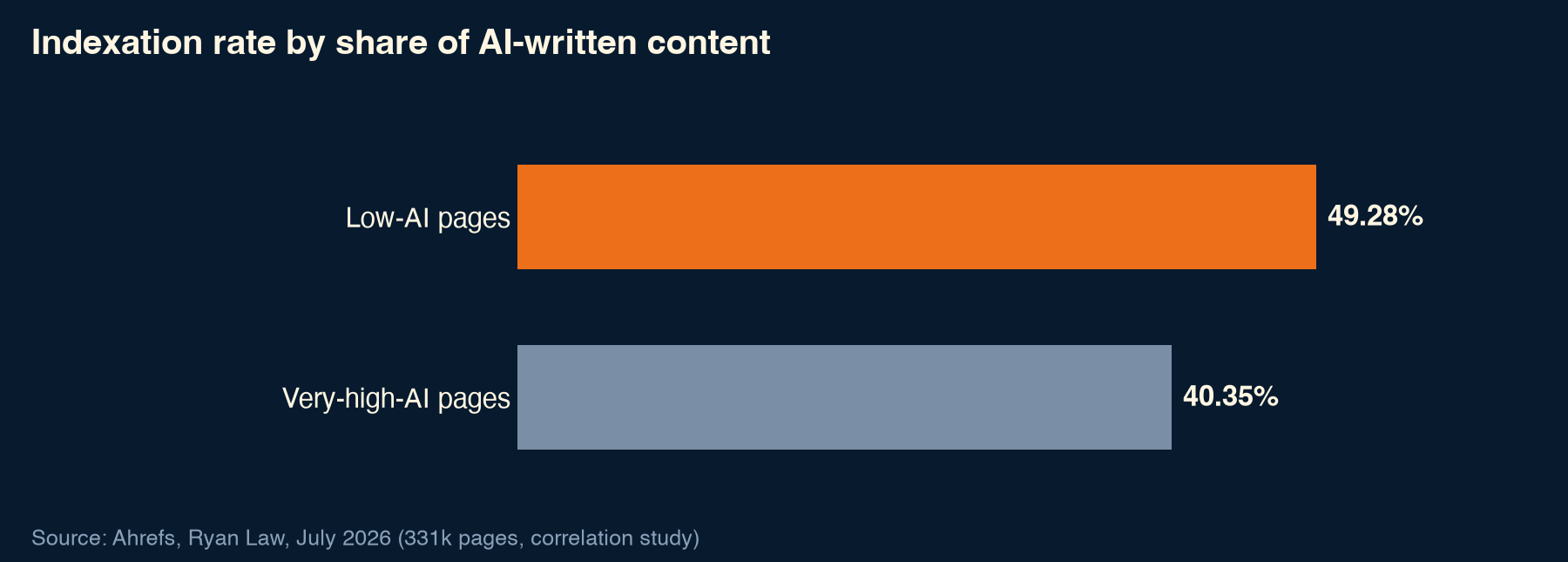 So is AI content bad for SEO? The tool itself is neutral. The rankings drop when the review step drops out. SEO and AI content work well together when a person who knows the subject decides what gets published.
What actually gets sites hurt
Google has been specific about the patterns it treats as low value. Each one below has a supervised fix. For the wider business cost of these patterns, see the hidden cost of unsupervised AI in digital marketing.
Unhelpful content published without oversight
Google's people-first content page includes a warning-sign question for site owners: "Are you using extensive automation to produce content on many topics?" When we see this pattern, it usually began with good intentions. A content calendar gets handed to a tool, the drafts go live unedited, and nobody checks whether each page answers a real customer question. The cost shows up later, as organic leads that never arrive.
Fake author personas
Some sites invent experts to look more credible. Google says plainly that "Fabricating creator profiles (such as by using AI-generated headshots, made-up names, or false credentials to make content appear as if it was written by human experts) is a form of deception." Credibility is built with real people who have real credentials, named on the page.
What quality raters are told to look for
Google pays human quality raters to assess search results against its Search Quality Evaluator Guidelines (version dated September 11, 2025). Their ratings do not directly change rankings. Google uses them to check how well its systems are working. Even so, they show what Google counts as quality.
Section 4.6.6 says: "The Lowest rating applies if all or almost all of the MC on the page (including text, images, audio, videos, etc) is copied, paraphrased, embedded, auto or AI generated, or reposted from other sources with little to no effort, little to no originality, and little to no added value for visitors to the website." "MC" means main content, the part of the page that exists to serve the visitor.
The same document balances that rule: "the use of Generative AI tools alone does not determine the level of effort or Page Quality rating. Generative AI tools may be used for high quality and low quality content creation." Section 2.1 adds: "Generative AI can be a helpful tool for content creation, but like any tool, it can also be misused."
A site-level example
Ahrefs' review of the biggest SaaS traffic losers of 2024 looked at Causal. The company used generative AI to publish 1,800 articles cloned from a competitor's sitemap and, according to Ahrefs, "lost an estimated 99.52% of their organic traffic as a result of a Google manual penalty." Estimated monthly organic traffic went from 307,158 in 2023 to 1,485 in 2024. This is Ahrefs' analysis, based on third-party traffic estimates. Google has not publicly confirmed the manual action.
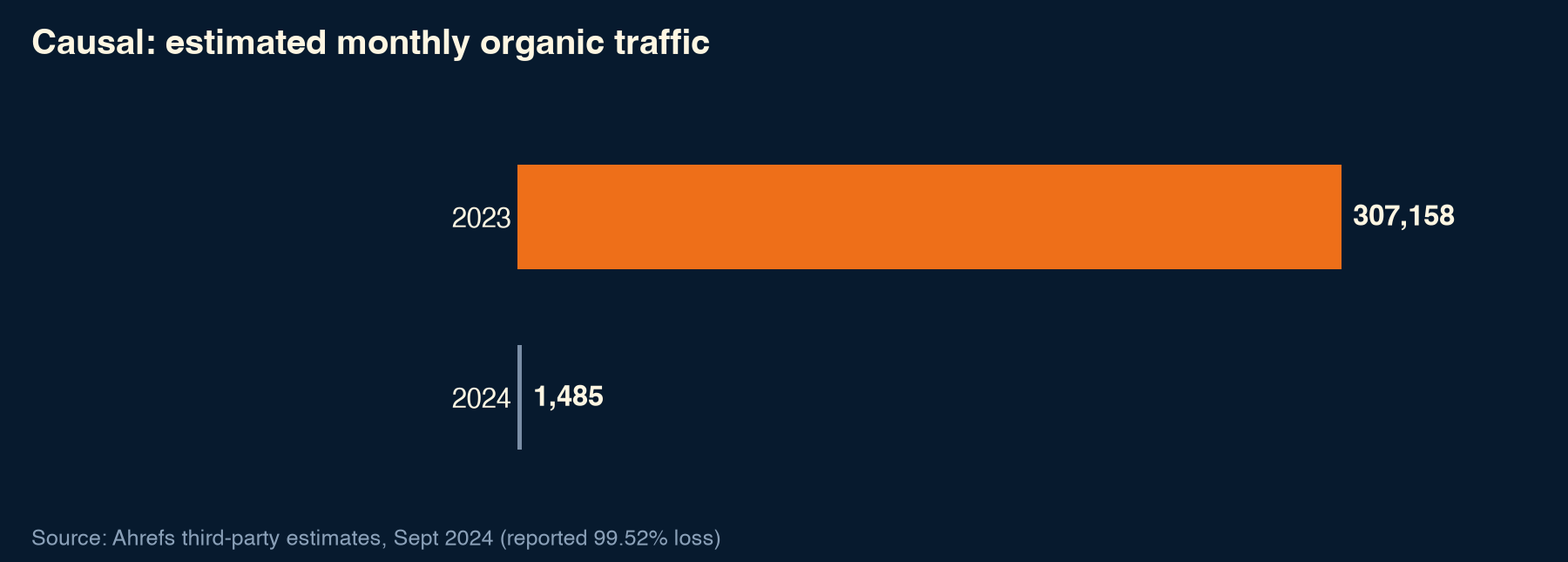 The lesson isn't about AI. It's about publishing at speed to win rankings, with nobody checking what went live.
The Google helpful content update, and what changed in March 2024
The Google helpful content update started as its own system. In March 2024 it became part of the core ranking update. Writing for Google Search Central on March 5, 2024, Chris Nelson explained that the update "is designed to improve the quality of Search by showing less content that feels like it was made to attract clicks, and more content that people find useful." He added: "It also marks an evolution in how we identify the helpfulness of content."
Google's launch target was to "reduce low-quality, unoriginal content in search results by 40%," and, as noted above, it later reported 45%. Both figures describe low-quality, unoriginal content, whatever produced it.
Helpful content update recovery
Google's own advice is reassuring: "There's nothing new or special that creators need to do for this update as long as they've been making satisfying content meant for people." Recovery means making your pages that kind of content. We don't promise timelines, because Google doesn't either. The practical steps:
- Start with an SEO audit to find thin, duplicated or underperforming pages.
- Improve, merge or remove thin AI pages instead of adding more.
- Add first-hand expertise, examples and sourced facts.
- Put real, named authors on the pages.
How to avoid an AI content penalty: a supervised-AI checklist
AI is excellent at research, outlines and first drafts. How to avoid an AI content penalty comes down to what happens before you hit publish. We use the following checklist, and it applies equally if your team is using ChatGPT for SEO or any other tool:
- Write an expert brief before drafting. Someone who knows the subject sets the angle, audience and sources.
- Have a human edit for accuracy and voice. Every claim is checked, and the copy sounds like your business.
- Source and link every statistic. If you can't name where a number came from, cut it.
- Add what AI cannot know. First-hand experience, your own examples, your own data.
- Name real authors with real credentials. No invented personas.
- Publish because a page is useful, not because it is cheap. Volume is not a strategy.
- Check for leftover AI phrasing. Google's rater guidelines cite lines like "As an AI language model" as a telltale sign.
- Review before publishing, not after a traffic drop.
- Audit your content regularly. Refresh, merge or retire pages that no longer earn their place.
How Ascend Group Media uses AI in SEO content
At Ascend Group Media, we use AI where it helps: faster research, structured outlines and quicker first drafts. Experienced SEO strategists and editors own the brief, the review and the final QA, so every page we publish has a person accountable for it. That model runs through our search engine optimization services and our content creation work, and it gets your business the speed of AI without the risk of publishing on autopilot.
Google does not penalize AI content, and with the right review process AI can help your site grow. If you'd like a second opinion on your existing AI-assisted pages, contact us and we'll review them with you.
Frequently Asked Questions
Does Google penalize AI-generated content?
No. Google says "Appropriate use of AI or automation is not against our guidelines," and its focus is the quality of content, "rather than how content is produced." Sites get hurt when they publish unhelpful content without review, or use automation mainly to manipulate rankings, which breaks Google's spam policies. The tool doesn't trigger the problem. The missing editorial oversight does.
Does AI content rank in Google?
Yes, when it's helpful. Google says that if AI content "is useful, helpful, original, and satisfies aspects of E-E-A-T, it might do well in Search." Ahrefs' 600,000-page study found the correlation between AI use and ranking "was just 0.011," which suggests the production method barely matters compared with the page's quality and usefulness.
Can Google detect AI content, and does it matter?
What matters is helpfulness, not detection. Google says its systems "are looking at the helpfulness of content, rather than how it is produced." Its rater guidelines also say "the use of Generative AI tools alone does not determine the level of effort or Page Quality rating." Rater ratings don't directly change rankings, but they show the standard Google applies: effort, originality and value.
How do I know if my website has been penalized by Google?
Start with the Manual Actions report in Google Search Console, which lists any manual penalty applied to your site. Then look at your organic traffic over time and check whether any sharp drops coincide with announced Google updates. A drop that matches an update usually points to quality issues rather than a manual action, and a content audit is the sensible next step.
Is Google's policy different for human-written and AI-written content?
No. Both are judged against the same quality standard: original, helpful, people-first content that shows E-E-A-T. Google's guidance focuses on "the quality of content, rather than how content is produced." The one difference is that pages produced with generative AI "without manual oversight or curation" are described as representing "little to no effort."
How do I avoid a Google penalty for AI-generated content on my blog?
Run every post through a supervised process. Start with an expert brief, have a human edit for accuracy, source every statistic, add first-hand experience, name real authors and review before publishing. Don't publish at volume just because AI makes it cheap. Audit older posts regularly and improve or merge the thin ones.
Resources
- Google Search's guidance about AI-generated content, Google Search Central Blog, Danny Sullivan and Chris Nelson, February 8, 2023
- Creating helpful, reliable, people-first content, Google Search Central, accessed October 23, 2026
- March 2024 core update and new spam policies, Google Search Central Blog, Chris Nelson, March 5, 2024
- New ways we're tackling spammy, low-quality content on Search, Google The Keyword, Elizabeth Tucker, March 5, 2024 (updated April 26, 2024)
- Search Quality Evaluator Guidelines, Google, version dated September 11, 2025
- Google doesn't punish AI content, Ahrefs, Ryan Law, July 27, 2026
- Ahrefs study finds no evidence Google penalizes AI content, Search Engine Journal, Matt G. Southern, July 8, 2025
- The 25 Biggest Traffic Losers in SaaS in 2024, Ahrefs, Ryan Law, September 9, 2024
- Google: AI content is not by default well received by its algorithms, Slashdot, July 19, 2023
From the blog.



Let’s put this to work for you.
Tell us where you want to go. We’ll map the fastest path to revenue, no obligation.