
Google Performance Max is Google's goal-based campaign type that reaches all Google Ads inventory, including YouTube, Search, Gmail and Maps, from a single campaign. It can work very well. Left unattended, though, it can overlap the Search and brand campaigns you already run and spend budget in places nobody on your team has looked.
That overlap is common. An Optmyzr study found that "91.45% of 503 accounts had keyword overlap between Search and PMax."
This guide is for business owners and marketing managers who run Google Ads Performance Max, or have been told to try it, and want to know whether it is safe to leave on. Our short answer is yes, as long as someone is watching it. That is the pattern behind the hidden cost of unsupervised AI in digital marketing: the tool is useful, and leaving it on autopilot is where the trouble starts.
Contents
- What is Google Performance Max?
- Why Performance Max campaigns are worth using
- What happens when nobody is watching Performance Max
- The impact of Performance Max when the controls stay switched off
- Should you exclude your brand from Performance Max?
- Performance Max vs Search campaign: how they share queries
- The Performance Max supervision checklist
- How Ascend Group Media runs Performance Max
- Frequently Asked Questions
- Resources
What is Google Performance Max?
Google Ads Help describes Performance Max as "a goal-based campaign type that allows you to access all Google Ads inventory" from one campaign. You choose the goal, such as sales or leads. You supply asset groups (your headlines, images and videos) and audience signals. Google's AI then picks the channel, the audience and the mix of assets for each auction.
That is how Google Performance Max works. You provide the inputs and the target, and the system makes placement decisions you would otherwise make campaign by campaign. So your inputs carry a lot of weight. The campaign optimizes toward whatever you tell it counts as success, and that includes the parts you never got around to setting.
Where Performance Max ads appear
Google says the campaign reaches inventory "including YouTube, Display, Search, Discover, Gmail, and Maps, from a single campaign." That gives you six surfaces:
- YouTube
- Display
- Search
- Discover
- Gmail
- Maps
Shopping ads run through Performance Max as well. As we cover below, the reporting groups them under Search.
Why Performance Max campaigns are worth using
The big advantage is reach. One campaign, one budget and one set of assets can cover every Google channel. If your team has no dedicated YouTube or Display specialist, that is coverage you would struggle to build by hand.
Even the researchers who track the overlap don't tell advertisers to turn it off. Optmyzr's advice is to "Use PMax where it performs best: as a complement to your Search campaigns, not a replacement for them." In our experience, that is the right way to think about it.
Google also keeps adding controls in response to advertisers. Negative keywords reached Performance Max in early 2025 with a cap of 100. PPC Land reported that Google raised the cap to 10,000 on March 10, 2025. Ginny Marvin, Ads Product Liaison at Google, explained why: "We heard your feedback loud and clear that while negative keywords are welcomed, the cap of 100 felt too restrictive." That is a platform listening to advertisers, and the set of supervision tools keeps growing.
What happens when nobody is watching Performance Max
None of the gaps below are flaws in the product. Each one has a fix, but the fixes only work once someone sets them up and keeps reviewing them.
It can overlap your Search campaigns, including exact match and branded terms
Google's rules favor your Search campaigns, with conditions attached. According to Google Ads Help, "Search campaigns containing an exact match keyword are prioritized to serve over Performance Max." That only applies when the keyword is identical to the query and eligible to serve. Google also says brand Search campaigns need "sufficient budget and high-quality, eligible ads."
When those conditions slip, Performance Max can take the query. Optmyzr found overlap in 91.45% of 503 accounts, and "The overlap was identified for all match types, including exact match keywords." It also named the usual cause: "That ineligibility can stem from mismatches in location targeting, ad schedules, audience exclusions, or budget constraints." If your brand campaign runs out of budget or runs on a narrower schedule, the query goes to Performance Max and nobody is told.
How to exclude your brand from Performance Max, and what brand exclusions miss
The Performance Max brand exclusions page in Google Ads Help says "Brand exclusions keep your campaigns from serving for branded queries you want to avoid." They also do something negative keywords can't: "Unlike negative keywords, these exclusions will help block traffic with clear misspellings."
Check the scope before you rely on them. "For Performance Max, brand exclusions apply to only Search, Shopping, and YouTube search inventory." You also have "the option to allow your Shopping ads to appear in searches for excluded brands," so make that choice on purpose rather than leaving it at the default. Optmyzr adds one more warning: "Even with brand exclusions enabled, PMax can still trigger ads for fuzzy matches that dilute your brand's performance data." Exclusions reduce the overlap, and the search terms report shows you whether they actually worked.
Placement exclusions in Performance Max
If you set no exclusions, the system chooses your YouTube and Display placements for you. Google's Performance Max FAQ explains that "Placement exclusions stop your ads from showing on specific YouTube and Display content," and that "Performance Max respects all your account and MCC-level placement exclusions." (An MCC is a manager account that controls several ad accounts.)
PPC Land reports that Google turned on account-level placement exclusions on January 15, 2026. One list now applies across Display, YouTube, Performance Max and Demand Gen. Matching is exact, with no wildcards, and the feature appeared to still be in beta for some accounts, so check what yours shows.
The reports exist now, but someone has to read them
In August 2025, Google announced that "you can now access search terms reporting for all Performance Max campaigns and through the API," along with "full asset stats which are now available in all Performance Max campaigns." Google announced the channel performance report as a beta at Google Marketing Live 2025. Smarter Ecommerce says "It gives advertisers a view into where their PMax campaigns are serving," and adds a caveat: "Confusingly, Google groups Shopping ads under Search."
Google has given advertisers the dashboard, but someone still has to read it. Auto-applied recommendations carry the same lesson: automation keeps working whether or not anyone reviews what it did.
The impact of Performance Max when the controls stay switched off
Optmyzr's 2024 study of 9,199 accounts and 24,702 campaigns found that "the majority of advertisers don't use exclusions (brand lists, negatives, topics, and placements)." Brand lists were the least used: "almost no advertisers use the brand list exclusions." Ninety-seven percent don't.
It is worth reading the result fairly. The same study found accounts with no exclusions "saw a slight improvement in performance when they had no exclusions, but it was ultimately flat." So the data doesn't show that exclusions always win. It shows most advertisers never tried them, and it was collected before the 2025 controls existed. Running Performance Max on autopilot mostly means decisions that never got made.
Should you exclude your brand from Performance Max?
This question has two honest answers. Across Haus customer experiments, reported by PPC Land, excluding brand terms produced 24% more incremental revenue on average (revenue the ads actually caused, rather than sales you would have made anyway). Every experiment showed a lower customer acquisition cost with brand excluded, by 19% to 60%, with an average of 40%.
Even so, including brand terms still won on incremental revenue in 50% of tests.
Both findings hold, so the right move is to test it rather than assume. Run brand included against brand excluded for a set period. Measure incremental revenue and acquisition cost, then decide based on what your own account shows.
Performance Max vs Search campaign: how they share queries
In plain terms, Google gives priority in this order. First, "A Search campaign with a keyword that exactly matches or is spell-corrected to a person's query" is preferred. Next, "If there are no keywords that exactly match the person's query across keyword match types," the campaign with the higher Ad Rank serves. Search themes, the query hints you give Performance Max, "carry the same priority as phrase and broad match keywords."
So which one performs better? Optmyzr compared campaigns where the exact keyword text overlapped. Search won on conversion rate 18.91% of the time and Performance Max won 6.17% of the time. In 74.92% of cases there was no significant difference, which Optmyzr defined as a gap smaller than 10%.
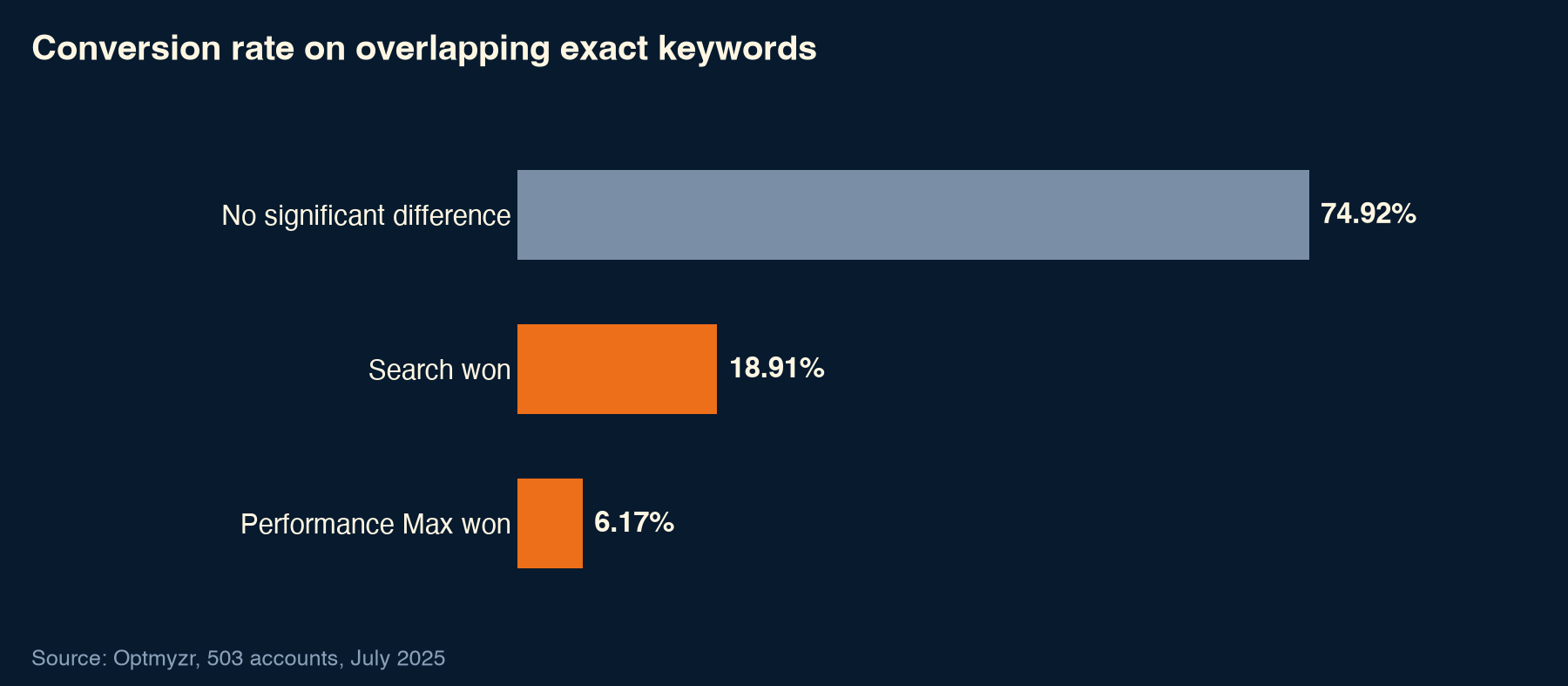 Most of the time, then, it's a tie, and when one side wins it is usually Search. Run both, keep Search eligible, and check which campaign takes each query.
The Performance Max supervision checklist
This is how to optimize a Google Performance Max campaign so the reach works for you. It's also what we check first in any account we take on.
- Keep brand Search campaigns funded and eligible. Google prioritizes them only with "sufficient budget and high-quality, eligible ads."
- Add brand exclusions, and decide deliberately whether Shopping may show on excluded brands.
- Exclude keywords with campaign-level negative keywords or negative keyword lists. Remember that "Negative keywords do not match to close variants," so add the variations yourself.
- Apply an account-level placement exclusion list to cover YouTube and Display.
- Read the search terms report and channel performance report on a fixed schedule, not just when results dip.
- Confirm your conversion goals are the ones that matter to the business. That's the number every PPC campaign should answer to.
- Test brand inclusion against exclusion before you settle on either.
| Control | What it covers | Watch for |
|---|---|---|
| Brand exclusions | Search, Shopping and YouTube search inventory only | Optional Shopping exception for excluded brands |
| Campaign-level negative keywords | Up to 10,000 per campaign, plus negative keyword lists | No close variants |
| Account-level placement exclusions | Display, YouTube, Performance Max, Demand Gen | Exact match, no wildcards |
| Search terms report | All Performance Max campaigns | Also available through the API |
| Channel performance report | Where your campaigns serve | Shopping grouped under Search |
Performance Max controls and their scope, from Google Ads Help and Smarter Ecommerce.
How Ascend Group Media runs Performance Max
Ascend Group Media uses Performance Max where it helps, and puts an experienced specialist in charge of setup, exclusions, reporting and testing. Through our paid advertising management, every campaign gets regular human review alongside the automation. If you run Meta too, the same principle applies to Meta Advantage+.
Google Performance Max does its best work with someone watching it. If you'd like a specialist to review your settings, exclusions and reports, get in touch with our team and we'll go through it with you.
Frequently Asked Questions
What is Google Performance Max?
Google Performance Max is a goal-based Google Ads campaign type that reaches YouTube, Display, Search, Discover, Gmail and Maps from one campaign. You set the goal and supply assets and audience signals. Google's AI then chooses the channel, audience and ad combination for each auction. It works best with someone setting its controls and reviewing its reports.
Is Performance Max worth it?
For most advertisers, yes, provided you treat it as a complement to Search rather than a replacement. Optmyzr found no significant conversion rate difference on overlapping exact keywords 74.92% of the time. The value comes from Google-wide reach, and supervision is what keeps that reach working alongside your existing campaigns.
Does Performance Max take traffic from my branded Search campaigns?
It can. Google prioritizes Search campaigns with an exactly matching, eligible keyword, but brand campaigns need "sufficient budget and high-quality, eligible ads." Optmyzr links overlap to mismatches in location targeting, ad schedules, audience exclusions or budget. If you keep brand Search funded and eligible and add brand exclusions, the overlap shrinks.
How do I exclude my brand from Performance Max?
Add brand exclusions to the campaign. Google says they keep campaigns from serving on branded queries and block clear misspellings, unlike negative keywords. They apply only to Search, Shopping and YouTube search inventory, and you can choose whether Shopping ads appear for excluded brands. Check the search terms report afterwards for any fuzzy matches.
Can you add negative keywords to Performance Max?
Yes. Google raised the campaign cap from 100 to 10,000 in March 2025. In August 2025 Google added "the ability to apply campaign-level negative keyword lists to your Performance Max campaigns." Note that negative keywords do not match to close variants, so add plurals and common variations yourself.
Can I see search terms in Performance Max?
Yes. Since August 2025, Google says search terms reporting is available for all Performance Max campaigns and through the API, along with full asset stats. The channel performance report shows where campaigns serve, though Shopping ads are grouped under Search. Read these reports on a set schedule.
Resources
- Google Ads Help: About Performance Max campaigns
- Google Ads Help: How Performance Max interacts with other campaigns in your account
- Google Ads Help: Apply brand exclusions to Performance Max or Search campaigns
- Google Ads Help: Answering Your Top Questions About Performance Max
- Google Ads Help: Unlock more visibility and control in Performance Max (August 7, 2025)
- Optmyzr: Search and Performance Max overlap study, Frederick Vallaeys (July 31, 2025)
- Optmyzr: Performance Max study, Navah Hopkins (October 7, 2024)
- PPC Land: Google raises negative keywords limit to 10,000 for Performance Max campaigns (March 11, 2025)
- PPC Land: Google gives advertisers one placement list to rule them all
- PPC Land: Haus analysis reveals insights on brand terms in Google Performance Max (August 24, 2024)
- Smarter Ecommerce: PMax channel report deep dive, Manuel Baudisch (May 22, 2025)
From the blog.



Let’s put this to work for you.
Tell us where you want to go. We’ll map the fastest path to revenue, no obligation.